

LLM SEO: The B2B Guide to Getting Cited in AI Search


More B2B buyers are researching solutions inside ChatGPT, Claude, and Gemini before they ever open Google. When they ask "best project management tools for mid-market teams" or "how to reduce endpoint response time," they get a curated shortlist. Not ten blue links. A shortlist.
Your brand is either on it or it isn't.
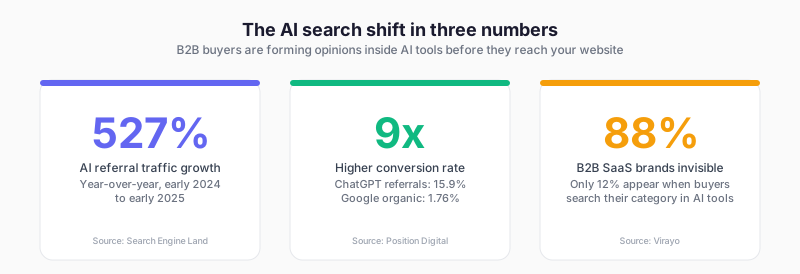
AI referral traffic grew 527% year-over-year between early 2024 and early 2025. ChatGPT now processes 2.5 billion prompts daily across 883 million monthly users. And the visitors who arrive from these AI tools don't browse and bounce. They convert. ChatGPT referrals convert at 15.9% compared to Google organic's 1.76%. That's a 9x difference.
Yet only 12% of B2B SaaS brands appear when buyers search their category in AI tools. The other 88% are invisible during the moment buyers are forming opinions, building shortlists, and narrowing choices.
TLDR: LLM SEO is the practice of getting your brand cited in AI-generated search responses from ChatGPT, Claude, Gemini, and Google AI Overviews. For B2B SaaS companies, LLM visibility is now a pipeline problem: buyers form opinions inside AI tools before they reach your website. The brands showing up earn higher-converting traffic and compound their advantage as models reinforce what they already know. This guide covers how LLMs find content, the five levers that drive citations, how to audit citation accuracy, and how to measure pipeline from AI search.
Key Takeaways
- LLM SEO extends traditional SEO: it earns your brand citations in ChatGPT, Claude, Gemini, and AI Overviews.
- Rankings feed retrieval: ChatGPT leans on Bing's index, and AI Overviews cite top-10 organic results over 93% of the time.
- Third-party presence (review platforms, Reddit, listicles) drives citations alongside your own content.
- AI referrals convert at 15.9% from ChatGPT, roughly nine times Google organic.
- Measure it like a channel: tracked prompts across models, citation accuracy, and a dedicated GA4 AI referral grouping.
What is LLM SEO?
LLM SEO is the practice of getting a brand cited in AI-generated search responses. When a buyer asks ChatGPT "best field sales management software" or Gemini "how to improve MSP client retention," the AI synthesizes an answer from multiple sources and names specific brands. LLM SEO is the work of becoming one of those named brands.
You'll see this called different things. GEO (Generative Engine Optimization). LLMO. AEO (Answer Engine Optimization). The naming debate is noise. What matters is the behavior change underneath it: B2B buyers are forming opinions inside AI tools before they reach a search results page, and the brands they encounter in those responses earn mindshare that can't be bought with ads.
The scope of the shift
This isn't a niche channel. 80% of tech buyers now rely on generative AI at least as much as traditional search when researching vendors. ChatGPT alone handles 87.4% of all AI referral traffic, with Perplexity at 12.1% and Gemini at 4.9%. Google AI Overviews now appear in over 25% of searches, up from 13% in early 2025.
Gartner predicts traditional search volume will drop 25% by 2026 as AI chatbots absorb discovery queries. IDC projects companies will spend up to 5x more on LLM optimization than traditional SEO by 2029.
For B2B SaaS marketers, the shift creates a specific structural problem. Buyers who previously searched "best RMM tools for MSPs" in Google, clicked three results, and filled out demo forms now ask ChatGPT the same question and get a curated answer with three to five named brands. If you're not one of them, you've lost the deal before your website loaded.
LLM SEO and traditional SEO work together
LLM SEO is not replacing traditional SEO. It's expanding it. SEO has always been about one thing: helping brands get discovered where target audiences research and make decisions. The surfaces change. The goal doesn't.
The two disciplines share significant overlap. Traditional search rankings directly feed LLM visibility because ChatGPT uses Bing's search index for 92% of its retrieval queries, and Google AI Overviews cite at least one top-10 organic result 93.67% of the time. Content that ranks well in traditional search is content that LLMs can find, retrieve, and cite.
Think of it as a Venn diagram, not two separate circles. The largest portion of what drives traditional rankings (topical authority, content quality, technical health) also drives LLM citations. LLM SEO adds new dimensions: brand mention velocity, multi-platform presence, structural parseability, and citation accuracy monitoring.
How LLMs find and cite content
Understanding how LLMs retrieve information explains why traditional SEO tactics don't fully translate and what to do instead.
Two pathways to LLM visibility
LLMs discover brands through two distinct pathways. The first is parametric knowledge: what the model learned during training from massive datasets like Common Crawl. This is long-term brand familiarity. If your brand has been consistently mentioned across authoritative sources for years, the model "knows" you. This pathway dominates 60% of ChatGPT queries.
The second is live retrieval through RAG (Retrieval-Augmented Generation). When a user asks a question that requires current information, the model searches the live web (primarily through Bing), retrieves relevant content, and synthesizes it into a response. This is where content freshness, technical accessibility, and Bing optimization become critical.
Both pathways matter, and they reinforce each other. A brand that's already in the model's training data gets a recognition boost when it also appears in live retrieval results. A brand absent from training data can still earn citations through strong live retrieval, but it starts from a colder position and needs stronger signals to break through.
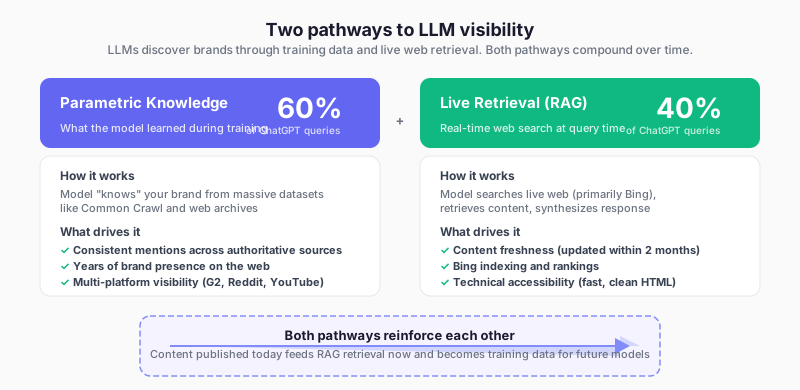
The practical implication for B2B SaaS teams: content published today influences both pathways. It gets indexed for live RAG retrieval immediately, and it becomes part of the training data future model versions learn from. Investing in LLM visibility now compounds across both pathways over time. See our SEO refresh framework for the specific cadence that maximizes LLM citations.
Why keyword density and link metrics fall short
Traditional SEO optimizes for keyword relevance signals and link authority. LLMs work differently. They use dense embedding search, which matches content based on semantic meaning rather than keyword overlap. A page can rank for "field sales tracking software" in Google through keyword optimization, but an LLM might retrieve it for "how do outside sales teams monitor rep activity" because the semantic meaning aligns.
This has three practical implications:
Platform differences matter
Each LLM retrieves and cites differently. ChatGPT matches Bing's top 10 results 87% of the time, making Bing optimization directly relevant. Perplexity leans heavily on Reddit, with 46.7% of its citations coming from the platform. Google AI Overviews pull from their own organic index, with 76.1% of cited URLs ranking in the top 10 organic results.
These retrieval patterns explain why a brand might show up consistently in Perplexity (strong Reddit presence) but never appear in ChatGPT (weak Bing rankings), or vice versa. Teams that optimize for only one model miss citation opportunities on the others. LLM SEO requires building presence across the sources all models draw from, not gaming any single model's retrieval preferences.
Five levers that drive LLM citations for B2B SaaS
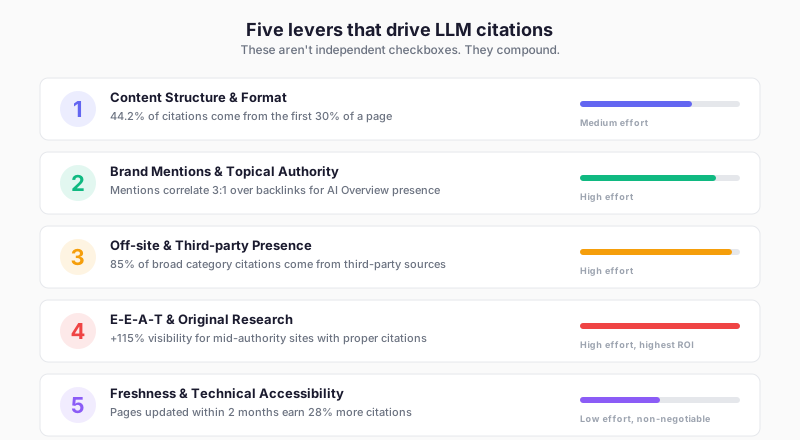
Research across multiple studies involving millions of AI sessions points to five factors that consistently determine which brands get cited. These aren't independent checkboxes. They compound.
1. On-site content structure and format
How you structure content determines whether LLMs can parse, retrieve, and cite it. The data is specific.
44.2% of LLM citations reference content from the first 30% of a page. Lead with your strongest, most specific claims early. Don't bury the answer after three paragraphs of context-setting.
Content with consistent heading hierarchies (H2 followed by H3, with bullets under each) is 40% more likely to be rephrased by ChatGPT. Optimal spacing between headings is 120-180 words, which earns 70% more citations than content with sparse or inconsistent heading structure.
Content format matters too. Comparative listicles ("Best X for Y") account for 32.5% of all AI citations, far more than any other format. Pages with FAQ sections earn 4.9 citations versus 4.4 without. Schema markup (Article, FAQPage, HowTo) correlates with a 44% increase in citations.
Longer content also performs better in LLM retrieval. Pages with 2,900+ words average 5.1 citations compared to 3.2 for pages under 800 words. Depth gives models more retrievable chunks to work with, but only when each section stands alone as a citable unit. A 3,000-word article with five strong, self-contained sections outperforms a 5,000-word article where every paragraph depends on the ones before it.
2. Brand mentions and topical authority
For LLM visibility, where your brand is mentioned matters more than where it's linked. This is the single biggest mental model shift from traditional SEO.
Sites present on four or more platforms are 2.8x more likely to appear in ChatGPT responses. Brands mentioned on Quora and Reddit have 4x higher citation likelihood. Third-party review profiles on G2, Capterra, and Trustpilot increase citation chances 3x.
LLMs evaluate authority through consensus signals. If a brand is mentioned consistently across Reddit discussions, G2 reviews, YouTube videos, and industry listicles, the model treats it as an established category player. A single high-DR backlink from a guest post doesn't create the same signal. Topical relevance beats raw domain authority for LLM citations. A niche DR30 blog covering a specific B2B SaaS category in depth can out-cite Forbes if the content is more contextually aligned with the query.
Topical authority on your own site reinforces this. Hub-and-spoke content architectures that cover a subject through multiple interlinked pieces signal deep expertise that both traditional search and LLMs reward. Your site's topical depth makes individual pages more retrievable, while off-site mentions make your brand more recognizable to the model. The two effects multiply.
3. Off-site and third-party presence
Here's the number that should reshape your LLM SEO strategy: for broad category queries, approximately 85% of citations come from off-site sources, not your own website. Brands are 6.5x more likely to be cited through a third-party page than through their own domain.
This means the majority of LLM SEO work happens off your website.
G2 and Capterra
Review platforms rank for software comparison queries across every B2B category. LLMs pull from these constantly for "best X" responses. A complete, current G2 profile with recent reviews is one of the highest-leverage investments for LLM visibility. Keep your feature descriptions, use cases, and ICP positioning current. Stale profiles with reviews from two years ago carry less weight than profiles with a steady cadence of recent, detailed reviews.
Particularly important for Perplexity (46.7% of citations) and increasingly for ChatGPT. Authentic community discussions carry high trust signals. Brands that get mentioned positively in Reddit threads about their category earn citations that paid placements can't replicate. The key is genuine participation. Users who only post about their own product get downvoted and ignored. Users who consistently add value in category discussions earn organic mentions that feed LLM citations.
YouTube
Video content is increasingly cited by LLMs, and YouTube videos appear in Google SERP carousels that feed AI Overviews. For B2B SaaS, product demos, implementation walkthroughs, and category education videos create citable touchpoints. YouTube also serves as an independent discovery surface where buyers research solutions before reaching your website.
Industry listicles and directories
"Top 10" and "Best" articles on third-party sites are the single most-cited format in AI responses. Getting included on authoritative listicles is one of the highest-leverage LLM SEO activities. Prioritize listicles that rank on the first page of Google and Bing for your category queries, since those are the pages LLMs retrieve most frequently.
Wikipedia and Crunchbase
For brand recognition in the parametric knowledge pathway, these sources carry outsized weight in model training data. A Wikipedia page (where notability criteria are met) and a current Crunchbase profile give models authoritative baseline information about your company that persists across model updates.
Each platform reinforces the others. A Reddit mention makes the model more familiar with your brand. A G2 listing with strong reviews validates the recommendation. A YouTube video with demonstrated expertise adds depth. The compound effect across platforms is what builds durable LLM presence, because the model encounters your brand from multiple independent sources, each reinforcing the same positioning.
This is the core of Virayo's multi-surface discovery approach: building brand presence across the entire search ecosystem, not just on your own domain. Single-touchpoint SEO is a limiting strategy for AI search. Owning your website's position 4 ranking while competitors dominate G2, Reddit, and third-party listicles means losing the 85% of citations that come from everywhere else.
4. E-E-A-T and original research
As AI-generated content floods the web, LLMs are increasingly prioritizing content that demonstrates genuine expertise and first-hand experience. Generic content gets commoditized. Original research, SME insights, and proprietary data earn citations.
The evidence supports this. Including statistics in content increases AI visibility by 22%. Including quotations from subject matter experts boosts visibility by 37%. Adding proper citations and references increases visibility by 115% for mid-authority sites.
For B2B SaaS brands, this translates to specific content investments:
Content that any competitor (or any AI tool) could generate doesn't earn citations. Content that only your team could write, based on your data, your clients' results, and your practitioners' experience, does.
5. Technical accessibility and content freshness
Two baseline factors determine whether LLMs can access and prioritize your content.
Freshness is non-negotiable. 65% of AI bot crawl activity targets content published within the past year. Content updated within the past two months earns 28% more citations than older content. Pages older than three months see sharp drops in citation rates.
Quarterly content refreshes aren't a nice-to-have. They're a prerequisite. This means building a systematic content refresh program that treats existing content as an ongoing investment, not a publish-and-forget asset. Every quarter, audit your top-performing pages for outdated statistics, deprecated features, and stale competitive framing. Update the `dateModified` timestamp when changes are substantive. LLMs check these timestamps to determine recency, and pages with current dates get retrieved more often.
Technical crawler access is table stakes. AI crawlers (OAI-SearchBot, Google-Extended, ClaudeBot) need to access your content without JavaScript rendering barriers. Server-side rendered, clean HTML content is preferred. Pages with First Contentful Paint under 0.4 seconds average 6.7 citations versus 2.1 for slower pages.
Additional technical considerations:
Why citation accuracy matters more than citation volume
Most LLM SEO advice focuses on getting cited. That's only half the problem. Being cited inaccurately can be worse than not being cited at all.
When an LLM describes your brand to a potential buyer, it might get the ICP wrong (positioning your enterprise product as an SMB tool), reference a feature you deprecated, describe your pricing model incorrectly, or frame your product as a competitor to a tool you actually integrate with. The buyer forms an impression based on that inaccurate description, and it follows them through the funnel.
Consider a concrete scenario: a B2B SaaS company selling endpoint management to mid-market MSPs discovers that ChatGPT describes their product as "an enterprise-focused solution starting at $50,000 annually." Their actual starting price is $3,000/month for 500 endpoints. Every MSP buyer who asks ChatGPT about their category now has a price anchor that's 67% higher than reality, and many will disqualify the vendor without ever visiting the website. The citation drove awareness and simultaneously killed pipeline.
73% of LLM citations are "ghost citations" where the model uses your content without naming your brand. We call this being sourced but not mentioned, and it is one of the most common visibility gaps in AI search. When it does name you, the description needs to be right.
How to audit citation accuracy
Run your category and competitor queries across ChatGPT, Claude, and Gemini. For each response where your brand appears, check:
How to correct inaccurate citations
LLMs form their understanding from the content they retrieve. To change how a model describes your brand:
Virayo's AI search audit process includes citation accuracy monitoring across all major LLMs, identifying where brands are being misrepresented and tracking corrections through subsequent model responses.
Measuring LLM SEO by pipeline impact
LLM SEO measurement is already more mature than most B2B teams realize. The reflex to treat AI visibility as a brand awareness metric and defer measurement misses a channel that's already generating pipeline.
Tracking LLM referral traffic
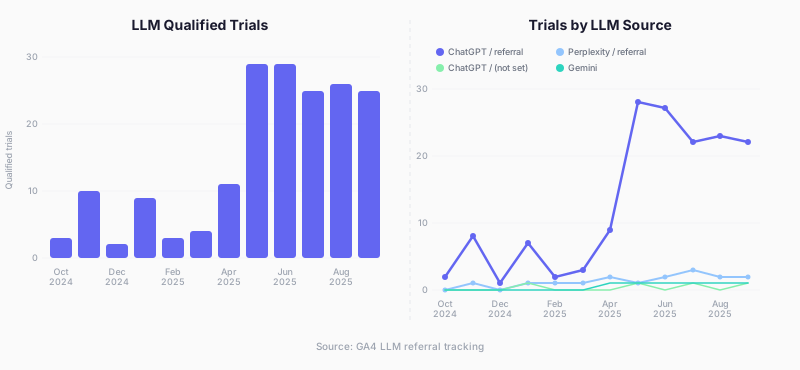
AI referral traffic is trackable in GA4. Sessions from chat.openai.com, perplexity.ai, gemini.google.com, and claude.ai show up as referral sources. You can create a custom channel grouping for "AI Search" to aggregate these sessions and measure them as a distinct channel.
The conversion data is compelling. ChatGPT referrals convert at 15.9%. Perplexity at 10.5%. Even the lowest-converting LLM (Claude at 5%) outperforms Google organic at 1.76%. Visitors from AI tools arrive pre-informed. They've already been told your product is relevant to their problem. The buying intent is baked in.
Webflow reports that 8% of their signups now come from LLM traffic, converting at 6x the rate of Google Search. One B2B SaaS company generates $100,000 in monthly revenue from ChatGPT referrals alone. See case studies with specific metrics that demonstrate these conversion patterns.
Teams that set up LLM referral tracking for the first time often discover they've had AI-sourced conversions for months without attributing them. The traffic shows up as referral traffic from chat.openai.com, but without a dedicated channel grouping, it gets buried in the general referral bucket alongside email signature clicks and social media previews.
Building a pipeline attribution model
LLM referral traffic is the measurable portion, but it underestimates actual impact. Many buyers who discover your brand in an AI response don't click the citation link. They Google your brand name directly, visit your site through a bookmark, or mention you to a colleague. The influence is real but shows up as direct or branded organic traffic.
Three approaches to capture the full picture:
Browse case studies from clients building LLM visibility to see attribution models in practice.
The metrics that matter
Common LLM SEO mistakes B2B teams make
Treating LLM SEO as separate from traditional SEO
The biggest strategic mistake is building an LLM SEO program divorced from your existing search strategy. Traditional search rankings feed LLM retrieval. Content that doesn't rank in Google or Bing is content that ChatGPT's RAG pipeline can't find. Start with a strong SEO foundation, then layer LLM-specific optimization on top.
Optimizing only your own website
When 85% of category citations come from third-party sources, an exclusively on-site strategy captures a fraction of the opportunity. The B2B teams winning in LLM SEO invest as much effort in G2 profiles, Reddit presence, industry directory listings, and third-party listicle placements as they do in their own blog content.
Publishing generic content that AI could generate
LLMs don't need to cite content that restates what they already know. When your blog post reads like a ChatGPT output, there's no reason for the model to retrieve and cite it. Original research, proprietary data, customer case studies, and SME perspectives give models new information worth citing. A benchmark report based on your platform's aggregate data, a case study with specific ARR impact numbers, or a technical walkthrough from your engineering team creates content no competitor can replicate.
Waiting for the channel to "mature"
AI models are training on today's content. The brands creating authoritative, well-cited content now are building the parametric knowledge that future model versions will draw from. This matters because parametric knowledge compounds in a way that's difficult to displace. Once a model "knows" a brand as a category leader, that recognition persists across model updates and reinforces itself through new training data. Late-movers face the same uphill battle that companies entering SEO in 2015 faced against competitors who started in 2008.
The GEO market is projected to reach $33.7 billion by 2034 at 50.5% CAGR. The land grab is happening now.
Not monitoring citation volatility
LLM responses are inherently volatile. 70% of content changes between repeated runs of the same query. Only 30% of brands remain visible in back-to-back responses. 36% of brands see visibility decline over a five-week period without active maintenance. LLM SEO is not a one-time optimization. It requires ongoing monitoring and content freshness, just like traditional search rankings require ongoing investment to maintain positions against competitors who are also publishing.
How to get started with LLM SEO
Step 1: Audit your current LLM visibility
Search your category in ChatGPT, Claude, Gemini, and Google (with AI Overviews). Use the queries your buyers actually use: "[your category] for [your ICP]", "[competitor] alternatives", "best [solution type] for [specific use case]," and problem-statement queries like "how to reduce [pain point your product solves]." Document where your brand appears, where competitors appear, and whether descriptions are accurate. Virayo's AI search audit process provides step-by-step guidance.
Step 2: Assess your multi-surface presence
Map your current visibility across the six surfaces that feed LLM citations: your own website, G2/Capterra, Reddit, YouTube, third-party listicles, and AI Overviews. Identify gaps. If you're strong on your own site but absent from G2 and Reddit, you're missing the platforms that drive the majority of LLM citations.
Step 3: Prioritize by impact
Not all queries are equal. Focus on the prompts where buyers are making purchasing decisions, not just researching concepts. "Best [category] for [your ICP]" and "[competitor] alternatives" queries are where LLM visibility directly influences pipeline. Our AI SEO insights demonstrate this pattern across client campaigns. Start there, not with broad informational queries where citation doesn't translate to pipeline.
Step 4: Build the content foundation
Structure existing high-performing content for LLM retrieval. Add clear, declarative statements early in each section. Include FAQ schema. Update timestamps. Ensure AI crawlers can access your pages. Then invest in the original research, case studies, and SME content that earns citations. Prioritize content types that LLMs cite most: comparison pages, category guides, and content with specific metrics and named experts.
Step 5: Expand off-site presence
Build or strengthen your G2 profile with current reviews. Participate authentically in Reddit discussions relevant to your category. Pursue placements on industry listicles. Create YouTube content that demonstrates expertise. Each platform you add increases your citation probability by expanding the consensus signal LLMs use to evaluate brand authority.
Step 6: Measure and iterate
Set up LLM referral tracking in GA4. Add self-reported attribution to your forms. Run monthly LLM audits to track share of voice and citation accuracy. Refresh content quarterly. Treat this like any other pipeline-generating channel: measure, optimize, compound.
Related resources
- 7 Top AI SEO Agencies to Consider
- LLM Content Optimization Checklist
- 10 Generative Engine Optimization Strategies
Show up where buyers research
LLM SEO isn't a separate discipline bolted onto your existing marketing. It's the next evolution of the same discovery strategy that has always driven organic B2B pipeline: showing up where buyers research, with content that earns trust, at the moment decisions are forming.
The difference is that "where buyers research" now includes ChatGPT, Claude, Gemini, and Google AI Overviews. The brands investing in multi-surface discovery across all of these platforms are compounding their advantage. The brands waiting are watching competitors get named on shortlists they'll never see.
Virayo helps B2B SaaS companies build integrated discovery programs that work across traditional search, AI search, and every surface where buyers evaluate solutions. We audit where you're visible (and where you're not), build the content strategy to earn citations, and track your LLM mention rate over time.
Search your category in ChatGPT right now. Check whether your brand shows up. Check whether the description is accurate. Then book a strategy call to discuss what you find.
Frequently asked questions about LLM SEO
Q: What is LLM SEO?
A: LLM SEO is the practice of optimizing a brand's presence in AI-generated search responses from tools like ChatGPT, Claude, Gemini, and Google AI Overviews. When buyers ask these AI tools category or product questions, LLM SEO ensures your brand gets cited accurately and consistently.
Q: Is LLM SEO replacing traditional SEO?
A: No. LLM SEO expands traditional SEO rather than replacing it. Traditional search rankings feed LLM retrieval because ChatGPT uses Bing's index for 92% of its searches, and Google AI Overviews cite top-10 organic results over 93% of the time. A strong SEO foundation is a prerequisite for LLM visibility.
Q: How do I track AI referral traffic?
A: AI referral traffic is trackable in GA4 through referral source data. Sessions from chat.openai.com, perplexity.ai, gemini.google.com, and claude.ai appear as referral sources. Create a custom channel grouping for "AI Search" to measure these sessions as a distinct channel alongside organic and paid.
Q: Which LLM sends the most referral traffic?
A: ChatGPT accounts for 87.4% of all AI referral traffic, with Perplexity at 12.1% and Gemini at 4.9%. ChatGPT referrals also convert at 15.9%, making it both the highest-volume and one of the highest-converting AI traffic sources for B2B websites.
Q: How long does it take to see results from LLM SEO?
A: Content changes can begin appearing in LLM responses within 30-90 days as models re-crawl updated content. Off-site presence building (G2 reviews, Reddit engagement, listicle placements) typically takes 3-6 months to compound into consistent LLM visibility. Building parametric knowledge (long-term model familiarity) requires sustained investment over 6-12 months.
Q: Do backlinks still matter for LLM SEO?
A: Backlinks still contribute to traditional search rankings, which feed LLM retrieval. But for LLM citation specifically, brand mentions across authoritative sources correlate 3:1 over backlinks. Sites with 32,000+ referring domains are 3.5x more likely to be cited, but this reflects overall brand authority more than individual link value.
Q: What content formats get cited most by LLMs?
A: Comparative listicles ("Best X for Y") account for 32.5% of all AI citations, making them the highest-performing format. Content with FAQ sections, structured data markup, and consistent heading hierarchies also earns significantly more citations. Longer content (2,900+ words) averages 60% more citations than content under 800 words.
Q: How is LLM SEO different from GEO?
A: They describe the same practice. GEO (Generative Engine Optimization), LLM SEO, LLMO, and AEO (Answer Engine Optimization) are all terms for optimizing brand presence in AI-generated search responses. The terminology is still consolidating as the category matures.