

The December 2025 Core Update: What’s Really Driving B2B SaaS Traffic Shifts Beyond AI Overviews


AI Overviews are eating B2B SaaS clicks. That much is clear. But when we analyzed a cross-section of our B2B SaaS portfolio through the December 2025 Core Update, the data revealed that AIO displacement is only part of the story. Spanning 11 verticals with domain ratings from 52 to 77, the patterns tell a more nuanced story than headlines suggest.
We ran the same methodology across every brand: 60-day pre versus 60-day post comparison, rollout window excluded, using GSC data, crawl stats, indexing reports, Ahrefs, and LLM visibility audits. About 70% declined. About 30% grew. The patterns are consistent enough to share publicly.
The December 2025 core update at a glance
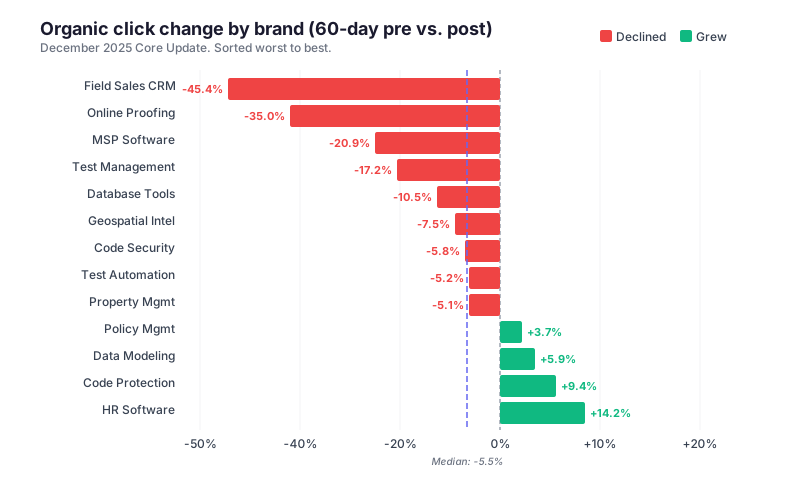
Google's December 2025 core update was the third broad core update of the year, rolling out from December 11 through December 29. Unlike the March and June updates, which focused on spam and site reputation, December's update expanded E-E-A-T enforcement across all competitive verticals and coincided with a significant expansion of AI Overviews into commercial and informational queries.
The result was widespread ranking volatility, with 40-60% of monitored sites experiencing measurable changes in organic visibility. B2B SaaS was not spared.
Based on analysis of a cross-section of our B2B SaaS portfolio where complete pre/post data was available, January-March 2026.
The story isn't just decline. Nearly a third of brands grew through the update, and the characteristics separating winners from losers are remarkably consistent.
AI Overviews displaced 1-68% of organic clicks, but it depends on what you publish
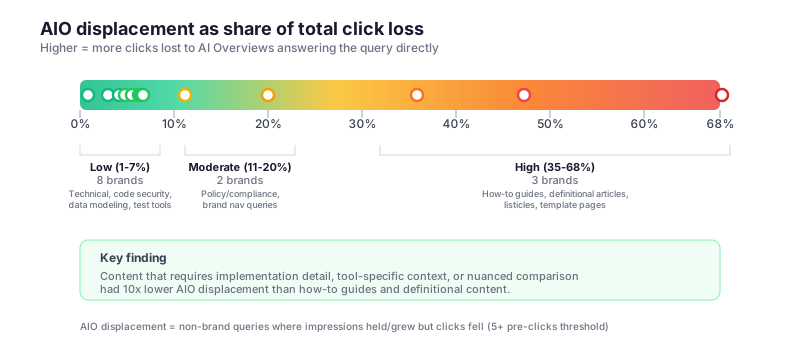
AI Overview displacement was present across every brand we analyzed, but the severity varied by nearly 70x. One brand lost 68% of its clicks to AIO; another lost less than 1%.
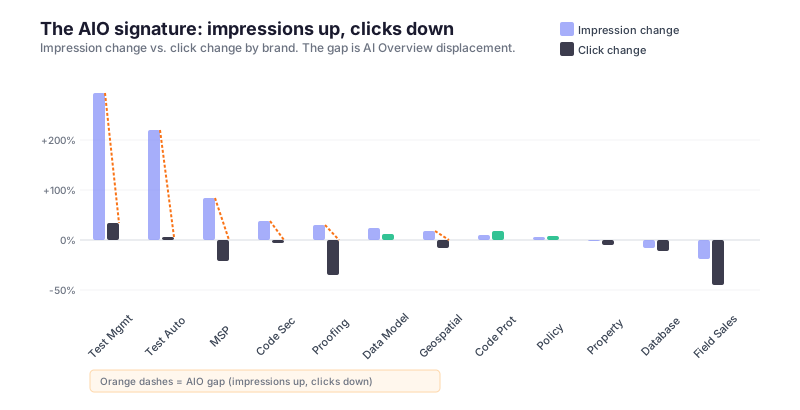
The mechanism is consistent. Impressions hold steady or surge while clicks fall. Google is serving these pages in more results than ever, but users aren't clicking through because the AI Overview answers the query directly. Positions barely move. This is not a ranking loss. It's a click displacement.
About a quarter of brands saw impression explosions exceeding 100% (one hit +294%) without proportional click gains. CTR collapsed from 3% to under 1% in the most extreme case. Google is showing these pages in dramatically more SERPs, including as AI Overview source citations, while the AI Overview itself absorbs the click.
The AIO vulnerability spectrum
The data reveals a clear spectrum:
- High vulnerability: Brands with large volumes of informational content like how-to guides, definitional articles, template pages, and listicles. One MSP software company saw 68% of its decline attributed to AIO displacing generic IT how-to guides. A field sales platform lost 47% to informational content about topics like solar panel design tools.
- Moderate vulnerability: Brands with policy/compliance content or brand navigational queries experiencing AIO interference. Even branded searches are being partially answered by AI Overviews.
- Low vulnerability: Brands with deeply technical content like data modeling, code security, test automation tooling, and database management. This content requires implementation detail and tool-specific context that AI can't fully summarize.
The pattern is clear. If the content answers a question Google's AI can summarize in three sentences, the click-through rate collapses. Content that requires hands-on implementation, nuanced comparison, or tool-specific expertise survives. This mirrors what we documented in our analysis of the evolution of AI in search.
What content types are most vulnerable to AIO displacement?
Informational content gets hit hardest across our portfolio. The biggest losers were:
- How-to guides and definitional articles (updating BIOS, changing DNS servers, checking Python versions)
- Template and listicle content (rent increase letters, policy procedure templates, shift schedules)
- Generic informational content answerable in three sentences by AI
- Learning center and knowledge base articles on broad topics
Commercial and transactional content has been more resilient. Product comparisons, pricing pages, and case studies retained clicks at higher rates because users still need to evaluate, compare, and make decisions that AI can't shortcut.
Topical authority is the single strongest predictor of update performance
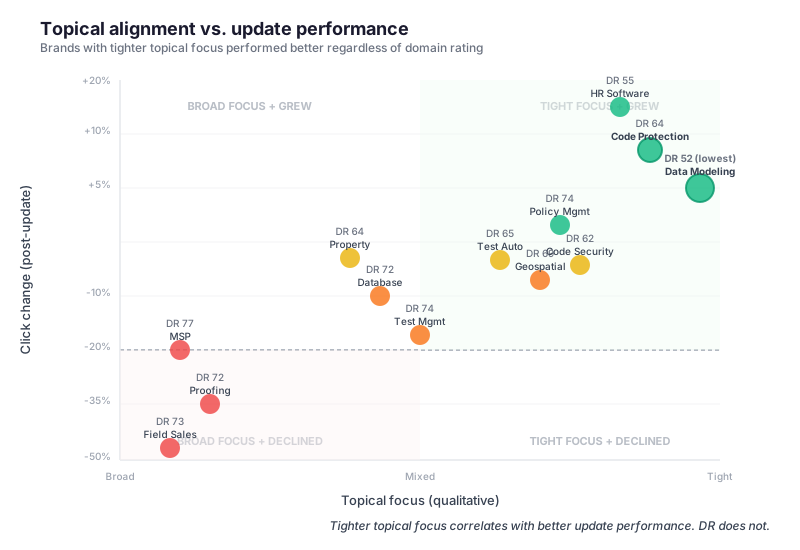
This is the most important finding in the entire analysis. The correlation between topical focus and update performance was tighter than any other factor we measured, including domain rating, content volume, brand share, or technical health.
The data modeling brand that grew the most (+6%) has the lowest domain rating in the analysis (52) and the tightest topical alignment. Everything on its site relates to data modeling, database design, or closely adjacent topics. Blog content grew +31%, glossary +32%, core product content +27%. Google rewarded depth over breadth.
A code protection company grew +9% on the strength of topically aligned blog content about code obfuscation, application security, and RASP tools. Its blog surged +62%. New pages on its core topic gained hundreds of clicks from zero.
Meanwhile, the worst performer (-45%) had built significant traffic on topics completely outside its core expertise. The second-worst (-35%) had 496 near-duplicate content pairs diluting every signal.
And in what may be the clearest proof, one database tools company saw its core content grow +2.7% while off-topic utility content on the same domain declined -17%. The update surgically rewarded topical relevance.
The emerging pattern
Google is asking: "Should this website be the authority on this topic?" Off-topic content that once drove traffic numbers is now a drag. The companies that grew are the ones whose content is tightly aligned with their core business, following a hub and spoke content strategy. High-volume, low-relevance content designed to cast a wide net is now potentially dragging down your core pages.
One MSP software company is the extreme case. 92% of its blog traffic came from generic IT how-to guides (updating BIOS, changing DNS servers, checking Python versions) unrelated to its core MSP/RMM platform. Those three topics alone accounted for 55% of total decline.
Brand SERPs are no longer safe
One client lost 44% of their total click decline from a single branded query, their own company name. They rank #1 and own all 10 organic positions. Impressions barely changed. But CTR dropped 20 percentage points.
Nothing changed about their brand or their rankings. Something changed about how Google renders the SERP, likely through AI Overview integration, knowledge panel expansion, or sitelink layout changes.
This matters because brand search represents 20-94% of a B2B SaaS company's organic traffic across our portfolio. When that channel erodes without any action on your part, it distorts every metric downstream.
Brand dependency is a double-edged sword
Brand-heavy sites (90%+ brand traffic) were the most likely to grow through the update, but only when brand demand was actually increasing. Some brand-dominant sites grew because brand interest grew and they had minimal non-brand content to get punished. But others declined despite 73-94% brand share because brand CTR eroded from AIO.
The most interesting group is the roughly 40% of brands that saw non-brand traffic grow through the update, ranging from +10% to +33%. Every one of them had topically aligned non-brand content. Non-brand growth is possible, for the right content.
Technical health correlates with performance but doesn't determine it
Crawl stats and indexing data across all brands show wide variance in technical health, from a 92% OK rate (best performer) down to a catastrophic 10% OK rate (one brand's crawl budget is 87% consumed by AdsBot hitting application subdomains).
But technical health alone doesn't predict outcomes. A test management platform has a healthy 77% OK rate but declined -17% due to content vulnerability. A rebranded HR platform has a poor 64% OK rate (dragged down by legacy redirect chains) but grew +14% on brand strength alone.
The strongest crawl signal: "Crawled but not indexed"
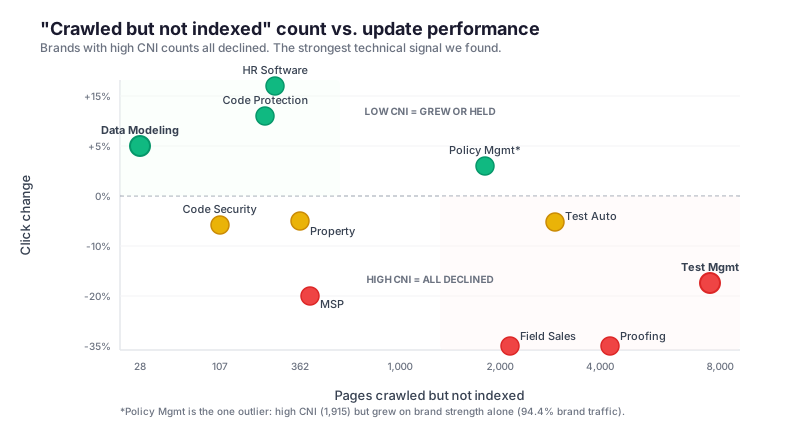
The most predictive technical metric isn't OK rate, 404 count, or AdsBot share. It's the "crawled but not indexed" (CNI) count, pages Google has crawled and rejected on quality grounds.
The brands with massive CNI counts (8,000, 4,600, 3,000, 2,400, 1,900) all declined. The brands with clean CNI counts (28, 107, 362) all either grew or experienced minimal decline. High CNI tells you Google has already evaluated and rejected a significant portion of your content.
Three distinct patterns of technical debt amplified the update’s impact:
Technical SEO is the difference between weathering an algorithm update and getting compounded by one.
LLM visibility is diverging from organic performance
Clients losing organic traffic can simultaneously be winning in LLM responses. We've been running LLM visibility audits, testing how ChatGPT, Claude, Perplexity, Gemini, and others represent our clients across dozens of prompts.
One client leads their competitive category in LLM responses with a 66% mention rate and zero inaccuracies across all major models. Another is #2 in their space but has nine active inaccuracies being repeated across multiple LLMs, including wrong pricing, incorrect market positioning, and a brand name misspelling. A third has strong organic rankings but eight visibility gaps. LLMs only know it for one product line, missing five others entirely.
Competitors and third-party sites define your brand in AI
The most actionable finding is that competitors and third-party sites provide far more source material to LLMs than our clients' own websites. In one case, a single competitor domain provided 2x more citation material than the client's entire site. Review aggregators like G2 and Capterra, competitor blog posts, and third-party listicles are what LLMs learn from.
If you're not actively managing your presence across those sources, someone else is defining your brand for every AI-assisted buyer interaction.
Two AEO failure modes
- Visibility fragmentation: Acquisition-driven companies where LLMs only know the legacy brand, missing entire product lines acquired over time.
- Narrative narrowing: Review sites reducing a multi-vertical platform to a single-use-case tool, which LLMs then repeat as fact.
What is LLM visibility and why does it matter?
LLM visibility measures how often and how accurately large language models mention your brand when users ask questions about your category. Unlike organic rankings, LLM visibility is shaped by the entire information ecosystem around your brand, not just your own website. It's becoming a leading indicator of buyer perception as more research happens through AI-assisted channels.
What actually held up and grew
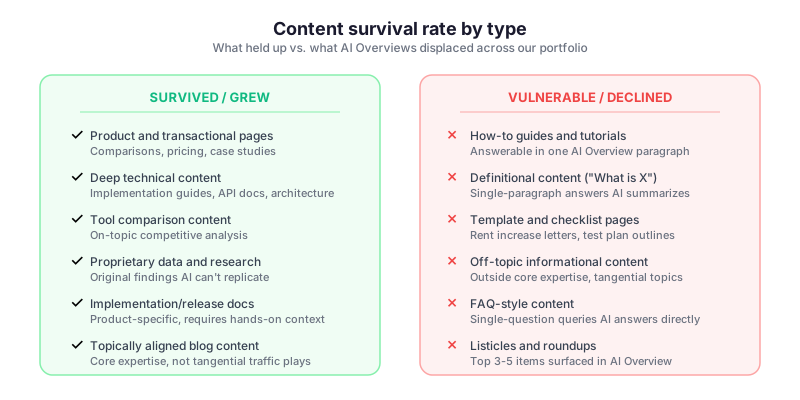
About 30% of brands grew through the update. What they share tells us what Google is now rewarding.
- Tight topical focus: Every growing brand has content tightly focused on its core product and expertise. The best performer has virtually no off-topic content. Everything relates to its core domain.
- Low AIO displacement: Growing brands had AIO displacement between 1-11%. Their content is too technical, too implementation-focused, or too product-specific for AI Overviews to fully summarize.
Content types that got hit across the portfolio:
- Generic how-to guides on topics outside the brand's core expertise
- Definitional and glossary content that AI Overviews now answer directly
- Template and checklist content (policy templates, test plans, letter templates)
- Learning center articles on broad informational topics
- Listicle content targeting high-volume, low-intent queries
What this means for B2B SaaS content strategy in 2026
The "traffic at any cost" era is over
The data across our portfolio is definitive. The brand with the lowest domain rating (52) and tightest topical focus grew the most. The brand with the broadest off-topic content declined the most. Stop producing high-volume, low-relevance content. A stack of thin how-to guides on tangential topics is worth less than one definitive piece on a topic where you have genuine authority.
Content needs to be AIO-resilient
AIO-resilient content provides value AI can't summarize in three sentences. Original research, proprietary data, interactive tools, downloadable frameworks, expert opinions with nuance. AI can answer "what is X." It can't replace "here's the exact playbook our team uses for Y, with the data to back it up."
Manage your LLM information ecosystem
The third-party ecosystem around your brand (review sites, competitor pages, industry listicles) now matters as much as your own blog for AI-assisted discovery. LLMs learn from these sources, and every AI-assisted buyer conversation is shaped by what those pages say about you. Show up where buyers actually research, not just where you publish. Here is our full guide to generative engine optimization strategies.
Redefine your success metrics
Organic click volume is now a misleading indicator because AIO displacement reduces clicks independently of content quality. Better measures include the following.
Technical SEO is foundational
Clean crawl profiles, healthy index rates, and low "crawled not indexed" counts are no longer optimizations. They're the baseline that determines whether your content survives a Google algorithm update or absorbs a deeper hit from one. The CNI count is the single most predictive technical metric we found.
Frequently asked questions
How long does recovery from the December 2025 core update take?
Core update recoveries typically take one to two update cycles (three to six months). Sites that address the underlying issues (off-topic content, thin content, technical debt) before the next core update are best positioned. Sites that only wait without making changes rarely recover automatically.
Should I delete content that lost traffic after the update?
Not necessarily. Evaluate each piece against two criteria. Does it serve your core topic authority, and can it be improved to be AIO-resilient? Content that fails both tests should be pruned or consolidated. Content that supports your topical authority but lost traffic to AI Overviews may still be worth keeping and improving with a structured content refresh.
How do I know if AI Overviews are displacing my clicks?
The signature is impressions holding steady or increasing while clicks drop. Check GSC for queries where your position hasn't changed but CTR has fallen significantly. If the SERP now shows an AI Overview for that query, AIO displacement is the likely cause.
What is AIO displacement?
AIO displacement occurs when Google's AI Overview answers a query directly in the search results, causing users to get the information they need without clicking through to any organic result. The page still ranks, still appears in the SERP, but receives fewer clicks because the AI Overview satisfies the user's intent before they scroll to the organic listings.
Can you still grow organic traffic after this update?
Yes. About 30% of our clients grew through the update. The common thread is tightly topical content that serves users who need implementation detail, tool-specific context, or nuanced comparison, not just definitions and summaries. About 40% saw non-brand traffic grow, ranging from +10% to +33%. The update rewarded topically aligned content.
How do I improve my brand's LLM visibility?
Start by auditing what LLMs currently say about your brand across ChatGPT, Claude, Perplexity, and Gemini. Identify inaccuracies. Then manage the sources LLMs learn from, including your G2 and Capterra profiles, review sites, competitor comparison pages, and industry publications that mention you. Your own website matters, but the third-party ecosystem around your brand matters more for LLM training data. See our LLM content optimization checklist for a step-by-step framework.
The December 2025 update didn't create these shifts. But it accelerated them dramatically. The companies best positioned going forward will be the ones that own their narrative across both organic and AI channels, focus on topics where they have genuine expertise, and measure success by pipeline and revenue rather than traffic volume. If you need help navigating these shifts, our B2B GEO team can help.